
A Brief History of Pontefract
The current town does not fully relay the importance of Pontefract during the Middle Ages.
At its height, Pontefract was the 4th largest town in modern day Yorkshire and its castle was deemed one of the most unassailable in the country. It was the main settlement of modern West Yorkshire.
Modern day Pontefract can be traced back to the Saxon times and featured in the Domesday Book, albeit as two separate villages. The two areas slowly merged and became known as Pontefract, or Pomfret, around the 12th century. The name Pontefract is taken from the Latin Pons – meaning bridge, and Fractus – meaning broken. The exact location of this broken bridge is still debated, as the nearest probable location of a bridge crossing over the River Aire is approximately 2 miles away.
Parallax Section by bPlugins
The Parallax effect is a modern web design technique where the background element scrolls slower than the foreground content. The parallax effect can be used on landing pages, long-form content, sales pages, or the homepage of a business website. It is a great way to highlight different sections on a lengthy page.
A Home to Kings
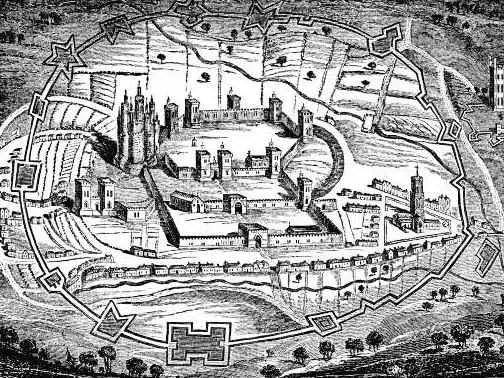
Pontefract Castle was built on the site of an earlier Saxon fort atop a rocky spur to the east of the current Market Place and town centre. It is unknown if the original Saxon keep was constructed from timber or stone. The elevated rocky plateau commanded great views as well as making it almost impregnable to attack. It was built by the Norman baron Ilbert de Lacy who arrived in England within the ranks of William the Conqueror at the 1066 conquest. William granted Ilbert the lordship of Pontefract as well as 150 other estates throughout Yorkshire. These estates that Pontefract Castle would soon regulate over included Leeds, Bradford and most of the land towards Huddersfield. Pontefract Castle later passed into royal ownership and was visited many times by various kings and queens. The unconquerable walls of the castle led it to be used for the secure holding of important prisoners.
The most famous prisoner held within Pontefract Castle was undoubtedly King Richard II. Richard didn’t survive his deposition for long. His death was announced in February 1400, but it is unclear exactly when or how he died. Forced starvation is currently deemed the most likely. Other prominent prisoners included the Dukes of Orleans and Bourbon, who were incarcerated in Pontefract Castle for thirty three years, and James I of Scotland who was also a fellow prisoner there at this time.
Civil War
Pontefract became a prominent castle and prison during the Wars of the Roses and the Civil War. Pontefract Castle found itself under siege on three occasions during the Civil War. On the outbreak of the Civil War between the King and his Parliament, Pontefract Castle was garrisoned by the King’s troops. After the fall of York, Pontefract Castle was soon under siege by Parliamentary forces led by Sir Thomas Fairfax and Colonel Lambert. The siege started in earnest on Christmas Day 1644 and continued until the 1st March when Sir Marmaduke Langdale led a Royalist army to success at the Battle of Chequerfield, Pontefract. The success of this battle lifted the First Siege of Pontefract Castle. The respite however, did not last long and the Royalist garrison did not get to enjoy their stronghold in peace as on the 28th March the Second Siege of Pontefract Castle was actively commenced and lasted four months until a treaty was signed and control of the castle switched to the Roundheads.
On the 3rd June 1648 Colonel Morris and Captain W Paulden, in disguise, tricked the parliamentary guard and gained control of the castle. This led to the third siege of Pontefract Castle in the following October. The Parliamentary forces once again quartered themselves before the castle and were soon joined by Oliver Cromwell leading the siege in person. After a month Cromwell returned south in preparation for the execution of Charles I. Following the execution of Charles I on January 30th 1649, the garrison at Pontefract Castle immediately proclaimed his son Charles II as the rightful king and were the first to strike a coin bearing his name. Rough coins were struck in order to pay the troops and included unusual diamond shaped pieces. The town’s motto still remains ‘Post Mortem Patris pro Filio’ (After the death of the father, we are for the son). In March Pontefract Castle stood alone as the last royal stronghold in the country. The futility of the garrison’s resistance was soon realised and conditions of surrender were settled. The town of Pontefract suffered badly during the Civil War and successfully petitioned parliament for its demolition.
A Secret Recipe for Success
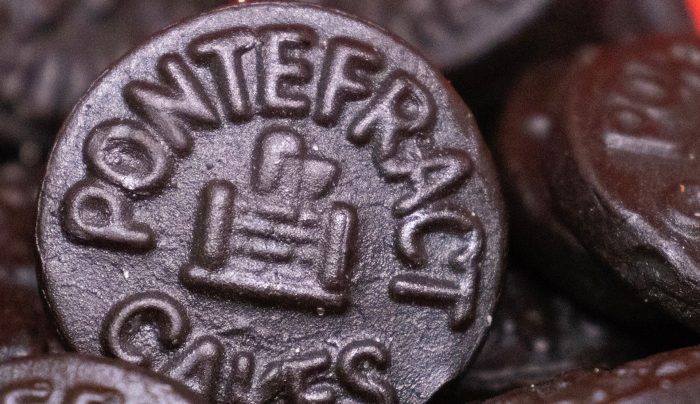
After the demolition of the castle the town turned its attention to rebuilding and repairing. Pontefract needed a new industry with which to fully recover, liquorice had the answer. It is believed that liquorice was first introduced to the country, and to Pontefract, by the crusaders returning from the Middle East. It was used originally as a medicinal planet. The first sweets didn’t appear until the 17th century. By 1742 it was a major industry as Paul Jollage’s map of that year describes the town and states ‘This town is sweetly situated and is remarkable for producing liquorice in great plenty’. Liquorice production and sweet making in Pontefract expanded vastly and was at its peak in the 1930’s with the famous Pontefract Cake shipped across the world. Chocolate soon overtook liquorice as the main sweet and demand for liquorice began to decline.
The hand stamp used to decorate Pontefract Cakes had another use in 1872. The Pontefract by-election of that year used the secret ballot system of voting for the first time in Britain, in fact, it was the first time in the northern hemisphere. You could say that democracy was born in Pontefract!
Parallax Section by bPlugins
The Parallax effect is a modern web design technique where the background element scrolls slower than the foreground content. The parallax effect can be used on landing pages, long-form content, sales pages, or the homepage of a business website. It is a great way to highlight different sections on a lengthy page.
A 300 Year Tradition
Horse racing at Pontefract was first recorded around 1720 and became more and more regular as the century continued. The grandstand was built in 1802 to accommodate the increasing number of spectators. In 1983 Pontefract Racecourse became the longest continuous flat racing course in Europe.
In the 16th century the town centred around the castle but during or after the Civil war the town centre began to shift as the current Market Place became the commercial centre where it still thrives today and on market day attracts visitors from the surrounding area.
Mick Turner is credited with the above history of Pontefract.